Tuesday, 7 June 2011

Tim Noble and Sue Webster


Tim Noble and Sue Webster are an incredible artistic duo based in England who have worked on a variety of related projects experimenting with trash and projected shadows. From looking at the rubbish they collect from the streets of London it is virtually impossible to determine a rhyme or reason to the apparent mess. However, once a projector is set up at just the right angle the art pops to life and animated shades are created with crisp and clear outlines delineating the controlled forms hidden with chaos.

Moss Map of Brighton


I made lots of little pots of moss to be placed over an enormous wall sized hand drawn map of Brighton. I wanted to create a living map of where people live or have lived in the city. On the opening night of the show which was held last week on Thursday for the Brighton University end of year show (the show itself was held in City College on Pelham street). I had a large green suitcase open with each little marker and by the end of the evening the map had been brought to life by these growing cultivations.


Susan Stockwell


UK artist Susan Stockwell uses maps to craft stunningly detailed dresses, often with political implications; the dress on the left is ‘Empire Dress’, a Victorian style created with maps of the British Isles, while the right-hand ‘Highland Dress’ depicts a traditional Scottish style made with maps of the Highlands. Stockton also creates ‘money maps’ including ‘America is an Imperial State’, left, made with Chinese yuan, and ‘Afghanistan – A Sorry State’, made with American dollars.

Shannon Rankin

Maine-based artist Shannon Rankin uses little discs of maps to create installations, collages and drawings “that use the language of maps to explore the connections among geological and biological processes, patterns in nature, geometry and anatomy. Using a variety of distinct styles I intricately cut, score, wrinkle, layer, fold, paint and pin maps to produce revised versions that often become more like the terrains they represent.”

Ramon Espantaleón


The First Apple series by Ramón Espantaleón is a tribute to New York, particularly in light of the upcoming 10th anniversary of the 9/11 attacks. Espantaleón recreates scale models of the cities in clay, painstakingly constructing each building at 1/65 scale, before using them to cast silicone molds which can then produce recreations made of epoxy resin and polyurethane. Espantaleón, a Madrid native who lived in New York on the day the World Trade Center fell, places these pixelated city blocks onto representations of the Twin Towers.

Matthew Cusick

These beautiful maps of roadways that “go nowhere”, weaving and curving around the world. “Maps provided so much potential, so many layers. I put away my brushes and decided to see where the maps would take me. I think collage is a medium perfectly suited to the complexities of our time. It speaks to a society that is over-saturated with disparate visual information. It attempts to put order to the clutter and to make something permanent from the waste of the temporary. A collage is also a time capsule; it preserves the ephemera of the past. It reconstitutes things that have been discarded. A collage must rely on a kind of alchemy; it must combine ordinary elements into something extraordinary.”

R. Luke Dubois


Touching and, at times, hilarious, these keyword maps by R. Luke Dubois associate each town with the terms most often used by locals to describe themselves and their desired partners on their online dating profiles. Dubois joined 21 dating websites and analyzed the language used in 21 million profiles to come up with the data, which was then displayed on maps. Chicagoans say things like “prankster”, “pizza”, “smoker” and “synagogue” while Central Texans are all about “churches”, “boundaries”, “barbecue” and “Madonna” – the latter presumably referring to the Virgin, not the pop star.

Nikki Rosato

Delicately interwoven like veins, the tiny green, blue and red strips of maps used to create these incredible sculptures are molded around a packing tape form to create a three-dimensional shape. Artist Nikki Rosato removes the land masses, leaving nothing but the roads and rivers behind, reinforcing the paper with wire as necessary.


“Through the removal of the land masses, the places almost become ambiguous since all of the text is lost. Unless someone really knows the roads and highways, it is almost impossible to identify the place.”

Guillermo Kuitca


Guillermo Kuitca looks upon maps as metaphors for human relationships. He routinely uses maps of individual and communal spaces as starting points for his paintings. Over the years, Kuitca’s has incorporated maps of all kinds into his work including floor plans for houses, stadiums, apartments, and prisons; seating arrangements of theaters; street plans of cities; and even family trees or genealogical charts into his work. While Kuitca’s paintings have an abstract appearance, they always have a psychological, political, or social reference.

In his series of paintings titled “People on Fire,” Kuitca brings together a community of faceless names together as one might do in a genealogical chart. These are anonymous individuals with no personal significance to Kuitca or to the viewer. We read the names as we might headstones in a cemetery. Names are color-coded by gender: male-orange, female-pink. Some spots are left blank which Kuitca sees as symbolic of the people unknown yet connected to the whole. These blanks may evoke no special feeling in the casual viewer. Yet to anyone aware of modern Argentine history, the missing names stand for the Desparecidos, the thousands of the artist’s countrymen and women who “disappeared” during the reign of terror brought by the military junta that ruled Argentina in the 1970s.

Maps...my latest obsession


Moss Traces 1988-2011(2011)

(Own Work)
Moss, paper, frame, plastic
Dimensions 350mmx300mm
‘For many living plants it is light which dictates the path they grow. For us, it is life itself which shapes our routes and how well we thrive.’
Traces 1988-2011(2011), were a set of four frames shown for a ‘First Thursday’ group exhibition at the Vyner Street gallery in Shoreditch, London. These outlines of road maps are drawn with intentional ambiguity and spread across the paper like roots or veins. The 26 tiny moss patches represent the 24 houses and 2 hotels that have been occupied in one lifetime to date and are living landmarks, plotting a growing journey which began from birth in 1988.   
All four frames were interspersed through the other artist’s work, some in lower spaces, another tucked into a top corner of the room. This is all to mirror the seemingly random path which has been taken and the opportunistic nature in which moss grows. It has not been random, but a very specific series of environmental factors which have shaped this course.

Helen Chadwick


Chadwick’s work explores themes such as time and decay, gender and identity, and the erotic and the cerebral.

Anya Gallaccio, Turner Prize winner


Monday, 30 May 2011

Moss Suitcase


This work was a development of Moss Trunk really. Moss is a loaded material not only for its aesthetic qualities but the things that moss conjures in the mind, of nature, carpeting woods and engulfing tree stumps or cities where it spreads in the shadows of back alleys around drains and other dank sources of moisture. I felt that with Moss Trunk the plant itself was quite literally too grounded. I wanted to make a piece which developed this sense of endless travel and thought of no better way to encompass this was to suspend the piece. With installation work you are asked to consider the piece in real-time and space so the fact that the piece itself was not grounded is integral to the work.


The piece itself was over a metre wide and isn't in fact a suitcase at all but was created using a large hand welded cage-like construction as the skeletal structure. The moss was all hand sewn to PVC covered mesh wire using garden wire then added to the outside of the structure. I removed the leather corners, locks and handle from an old suitcase and added them to the sculpture as an immediate familiar visual link. The inside was hollow to allow for the addition of fluid retaining liners or irrigation system for longer exhibition periods.

A work in progress...


Moss Trunk

This was an installation piece I did in a converted stall space in Brighton's Open Market. The show was titled 'Work In Progress'. This huge trunk was covered on the inside with moss which trailed up the wall and over the floor all the way to the drain. This was to suggest an uncertainty as to whether the moss was growing out of the trunk and into the drain or vise-versa. Not only does the nostalgic train trunk evoke thoughts of travel but the tiny mounds of moss themselves look like landscapes. I use moss as a material for it doesn't have roots in the same way as many other plants, is incredibly resilient in nature and in our cities resides in places such as alleys and other damp, dark dwellings. As a sculptural object alone with it's earthy smell and velvety texture I intended to create a pleasurable evocative piece which if left would continue to grow and given the right conditions could take over entirely.


compARTment


CompARTment are a group who I worked alongside to set up a group show with and are doing great things around Brighton. Contact them to get involved with some of their exciting creative projects

About
compARTment is a collective of artists, crafts people and social entrepreneurs from the slack space movement in Brighton who are looking to revitalize large empty/disused sites in the city.
compARTment aspire to transform these spaces into interim workshop and event spaces for learning, collaboration, work and community involvement.
compARTment will not only revive the empty site, but will draw positive attention to the property owner, the surrounding neighbourhood, local businesses and to the city itself.
We meet regularly in locations around Brighton and Hove.

Any comments or queries please contact us on info@compartment.org.uk.
Our email address is : info@compartment.org.uk

compARTment’s current location is : The Open Market
(Between London Rd & the Level)

Address:
UNITS 38&9
The Open Market
Marshalls Row
Brighton
BN1 4JS

Lori Nix

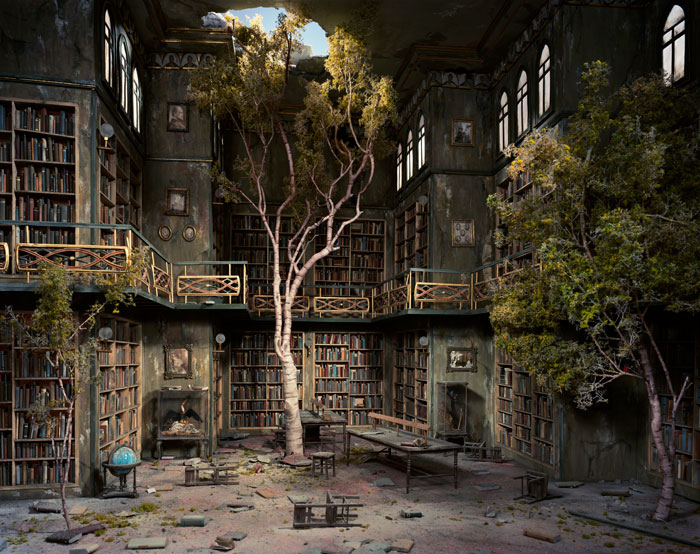
Lori Nix is a New York based artist who creates intricate and incredibly detailed miniature dioramas photographed to create huge scenes riddled with dark subject matter yet approached in a humorous way. Her work often deals with sociopolitical issues such as displacement


"Floater" is one of my favorite scenes to date. The viewer sees a dead body floating face down in the shallow waters, tangled amongst cattails and weeds. What I see is cardboard transformed into long leaves, cattails sculpted from polymer clay with my fingerprints still visible, and paper towel, carefully folded and painted to resemble a figure. All the elements came together to illustrate a grey, overcast, slightly rainy day, the kind of day one might stumble onto an unfortunate event. I really enjoy how this image came together to give the viewer a sense of unease, yet it's humorous if you pick the scene apart and see the materials used to construct it.
Lori Nix

Alfredo & Maria Isabel Aquilizan


Collaboration and collection, community and family, re-location and temporary homes, memory and identity are all processes and things that feature in the work of husband and wife team, Alfredo and Isabel Aquilizan. Originally from the Philippines, they have recently moved to Brisbane with their children. As they literally live the issues they deal with in their artwork, the Aquilizans are particularly focused on conveying the complexity of emotions associated with social dislocation, which emanate from necessity or a need for change.

In the series of developmental works associated with Project: Be-longing from 1999 to the present, the artists began by collecting personal items from Filipinos who had migrated to Australia and in their Dream Blanket projects (2002 in Japan and South Korea and 2005 in the USA), blankets and dreams, highly personal items, were collected to create installations.

There are two important threads that bind these works and the artists’ practices. First, the process of collecting the personal items and objects necessitates a collaborative framework. The collaboration between the communities and the Aquilizans provides a platform for dialogue and an exchange of ideas and as a result, new understandings and relationships develop. Secondly, these used items and objects, with their cumulative histories and personal, physical contact with the individual users, seem to embody the experiences and lives of the people. When presented in vast numbers in the artists’ installations, an overwhelming sense of shared and varied lived human experiences are communicated. The Aquilizans are therefore engaged in a process of collecting and presentation that is informed by what they observe outside and inside their own lived experiences.
Address (2007-2008) represents a developmental process spanning more than ten years since the first personal objects were collected 'cubed' by Balikbayan boxes. These are boxes that many Filipino migrants use to transport their personal belongings home. The Aquilizans used these boxes as moulds to 'cast' their own belongings as they moved from the Philippines to Australia. These 140 'cubes' of personal belongings are now 'bricks' used in the construction of Address, a room with a door but without a ceiling.
Address was exhibited in the Gallery of South Australia in the "Handle with Care" exhibition earlier this year. Installed at South Beach Development for the Singapore Biennale 2008, Address is a powerful reminder of things transient as the building itself is earmarked for massive re-development.
By Matthew Ngui
For Universes in Universe magazine

Moss Door


After noticing the growing cultivations dotted throughout the city-particularly mosses, I wanted to create a piece of artwork that suggested the spirit of perseverance and captured a sense of breaking free from the restrictions that hinder the paths things grow.

This was an installation at City College's Gloucester building in December last year using an existing door.


Michel Blazy


Saturday, 28 May 2011

Arte Povera:Jannis Kounellis

Jannis Kounellis was initially associated with the Italian Arte Povera of the late 1960s, a movement that tried to free art from the conventions, structures and the market place restrictions of the day, and also (through the nature of the materials used) to make an art much closer to the everyday life of people. In 1969 he was made famous by a work he presented in Rome in which he temporarily turned a gallery into a stable for twelve horses. Since then, through his continued pushing of the boundaries of what is considered art, Kounellis has remained at the forefront of developments in contemporary art.


While his works are perhaps best known for their frequently epic scale, it is in the details of their making that they are at their most human. Always made from a gathering of everyday materials (such as wool, sacking, used clothing, old musical instruments or pieces of steel), when grouped together these disparate ingredients take on new meanings and associations. In one famous untitled work from 1967, Kounellis cut a sheet of steel into the shape of a flower, and inserted a gas flame at its centre – the hard, metallic cold of the steel contrasting with the form of the inanimate flower, which in turn gave forth a hot, (life and death giving) lick of fire. In another piece from 2004, installed in a space filled with oriental carpets and covered by an army of falling steel crosses suggesting the encounter of two different cultures, he again contrasted the textures, strengths and uses of the materials, while reconnecting them to man through their histories.

Starting his career as a painter, Kounellis still describes his practice as painting. His first paintings were exactly the size of one of the walls in his house. Physical space then became his canvas and in this respect the actual making of his works also becomes something of a performance, in which the space is articulated by the placing of the objects within it. It is no surprise therefore that Kounellis works only within carefully selected spaces.

Born in the Greek port of Piraeus in 1936, Kounellis has lived in Rome since 1956. A key protagonist of Arte Povera, he is one of the world’s leading contemporary artists, with a career spanning more than forty years. He has exhibited all over the world, and is represented in major museum collections internationally. His first exhibition in Rome, in 1960, was entitled Kounellis’ Alphabet. Arising from a compositional relationship between living and inert materials, Kounellis’ new artistic language was intended to provoke a critical attitude towards society and the creative process. He chose to substitute canvas with steel, to which he applied his alphabet, made up, among other things, of fire, earth, coal, wool, plants, and living and dead animals.

Since his earliest works Kounellis has charged certain signs with metaphorical values and symbolic functions. Never restricting his ‘paintings’ to two dimensions, his works are an integration of different artistic forms: painting, sculpture, music, theatre and poetry.